
Discover how intelligent records platforms transform compliance, protect asset value, and streamline lease transitions for modern aviation fleets.
Table of Contents
- What is Aircraft Technical Records Software?
- Core Features of High-Performance Records Platforms
- Integration with MRO and Engineering Systems
- Maximising Asset Value During Lease Transitions
- ROAM: The Intelligent Evolution of Technical Records
What is Aircraft Technical Records Software?
Aircraft technical records software is a specialised digital platform engineered to manage the entire lifecycle of an aircraft's airworthiness and maintenance documentation. It moves beyond rudimentary cloud storage, providing a structured, searchable, and auditable environment for every critical document—from Airworthiness Directives (ADs) and Service Bulletins (SBs) to component certifications (such as EASA Form 1s) and maintenance task cards. The core purpose of this software is to establish and preserve a continuous, verifiable chain of airworthiness, ensuring that an asset’s history is transparent, complete, and compliant with global regulatory standards.
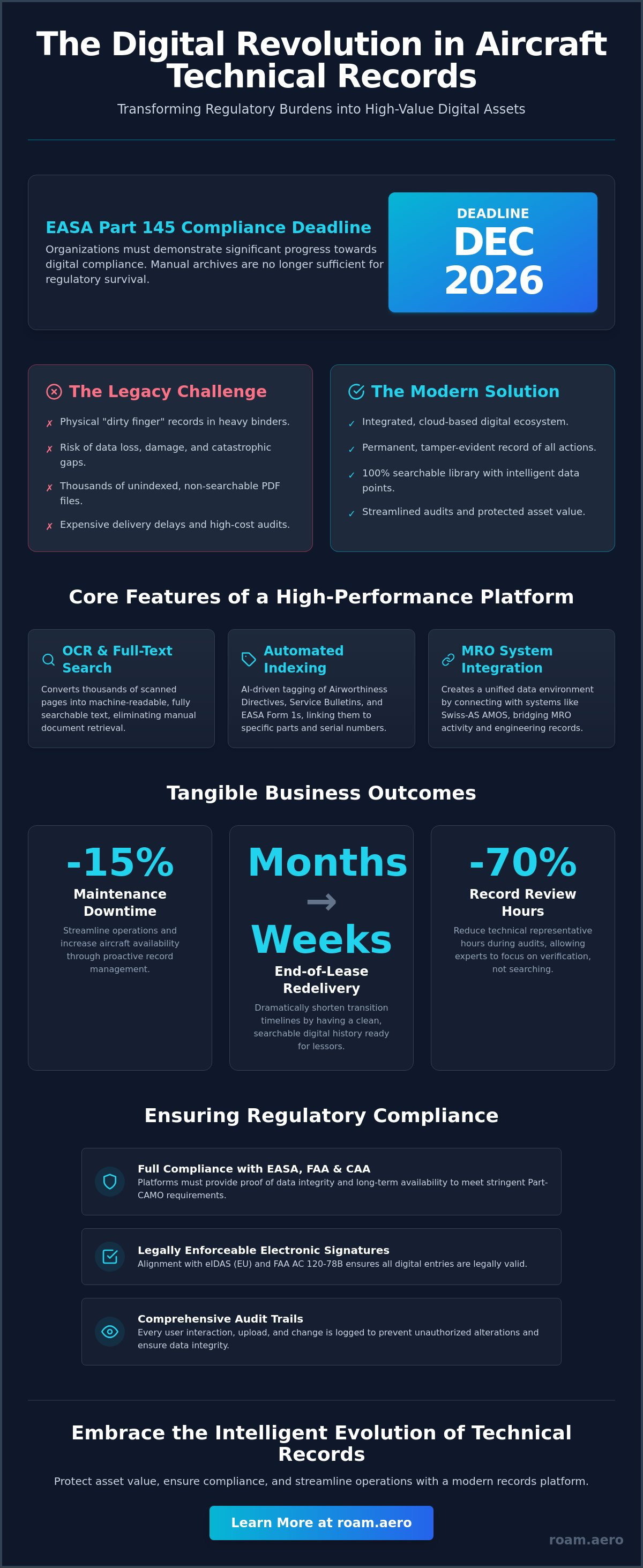
The aviation industry's evolution from physical, "dirty finger" records stored in vast paper archives to dynamic, cloud-based technical libraries marks a fundamental shift in operational philosophy. By 2026, the complexity of global fleet management, coupled with stringent regulatory oversight, demands more than simple PDF storage. True digital transformation requires intelligent systems that can interpret, categorise, and connect data points across millions of pages, turning a passive archive into a proactive compliance engine.
The Shift from Storage to Intelligence
Legacy filing systems, whether physical or basic digital folders, are fundamentally inadequate for modern technical audits. Their primary weakness is a lack of searchability and data correlation. An auditor or technical representative cannot efficiently query thousands of unstructured PDFs to verify the full back-to-birth history of a life-limited part (LLP). This is where intelligent software creates a paradigm shift. By employing sophisticated metadata, the software tags each document with critical identifiers—part numbers, serial numbers, flight hours, and cycles. This transforms a static file into a dynamic data asset, bridging the gap between MRO activity documented in systems like AMOS and the official engineering records that prove compliance.
Regulatory Compliance (EASA, FAA, CAA)
For airlines, lessors, and Continuing Airworthiness Management Organisations (CAMOs), regulatory compliance is non-negotiable. Modern aircraft technical records software is designed to meet the rigorous demands of authorities like the European Union Aviation Safety Agency (EASA), the Federal Aviation Administration (FAA), and the UK's Civil Aviation Authority (CAA). It directly addresses EASA Part-CAMO requirements for digital record-keeping, ensuring data integrity, security, and long-term availability. Features such as immutable audit trails and compliant electronic signatures are becoming standard requirements in 2026, providing regulators with the assurance that records are authentic, tamper-proof, and accurately reflect the aircraft's airworthiness status.
Core Features of High-Performance Records Platforms
In a market saturated with generic cloud solutions, high-performance aircraft technical records platforms distinguish themselves through a suite of specialised, aviation-centric features. These capabilities are designed not just to store data, but to activate it for compliance, operational efficiency, and asset value protection.
- Advanced Optical Character Recognition (OCR): State-of-the-art OCR engines that can read and digitise text from scanned documents, including handwritten notes and stamps across multiple languages, making every word searchable.
- Smart Indexing: AI-driven algorithms that automatically identify and categorise documents by type (e.g., AD, SB, Form 1, 8130-3), ATA chapter, and relevant aircraft or component, drastically reducing manual processing time.
- Asset Templates: Customisable digital structures for major assets like airframes, engines, APUs, and landing gear, ensuring all required back-to-birth and life-limited part documentation is correctly organised and tracked.
- Audit-Ready Dashboards: Real-time dashboards that provide an at-a-glance overview of record completeness, compliance status, and any identified gaps, allowing for proactive management before an official audit.
- Secure Multi-Tenant Access: Sophisticated, role-based security protocols that allow airlines, lessors, MROs, and regulators to collaborate within a single, controlled environment without compromising data confidentiality.
OCR and Searchability: Finding the Needle in the Haystack
Optical Character Recognition technology is the cornerstone of a modern records platform, enabling full-text search across thousands of scanned pages and transforming a static document library into an interactive database. This technology makes the critical distinction between an "image-only" PDF—which is little more than a digital photograph—and a fully "searchable" technical asset. For a technical director trying to locate a specific part number within a 30,000-page lease return package, this capability is revolutionary. By making every document's content instantly discoverable, advanced OCR can reduce the man-hours required for technical record reviews by up to 70%, accelerating audits and transitions.
Automated Indexing and Metadata Tagging
While OCR makes documents searchable, automated indexing gives them context and intelligence. Using AI and machine learning models trained on millions of aviation documents, the software can automatically identify a document as an Airworthiness Directive, a Service Bulletin, or an Authorised Release Certificate. More importantly, it extracts key metadata—such as part numbers, serial numbers, and compliance dates—and links the record to the specific component within the asset structure. This automated process is fundamental to streamlining the creation of a "Digital Birth Certificate" for new aircraft and maintaining a complete, auditable history for every critical part throughout its operational life.
Integration with MRO and Engineering Systems
Aircraft technical records software cannot exist as a data silo. To deliver maximum value, it must integrate seamlessly into the broader aviation IT ecosystem, particularly with the Maintenance, Repair, and Overhaul (MRO) and enterprise resource planning (ERP) systems that manage day-to-day operations. This connectivity ensures a single, consistent source of truth for airworthiness data, eliminating the discrepancies and manual data entry errors that arise when records and maintenance planning are disconnected. An API-first architecture is essential for this, providing the flexibility to connect with both current and future systems and future-proofing the organisation's data strategy.
Data Exchange with Swiss-AS AMOS
A premier records platform must be capable of sophisticated data exchange with leading MRO systems like Swiss-AS AMOS. Through secure API connections, the platform can match maintenance tasks and work orders generated in AMOS with the corresponding physical records and compliance documents. For example, when a life-limited part is replaced, the system can automatically flag the requirement for the incoming EASA Form 1 and link the certified document to the completed task. This level of integration significantly reduces manual workload in the engineering department, minimises the risk of human error, and ensures that the MRO system's data is perpetually validated by the official technical records.
Cloud Security and Data Sovereignty
Entrusting an entire fleet's airworthiness history to a cloud platform demands uncompromising security. Leading platforms utilise enterprise-grade encryption standards for all data, both in transit and at rest, to protect sensitive technical and commercial information. The architecture must also guarantee 24/7 global access, allowing onsite technical representatives at any location to retrieve necessary documents instantly. Furthermore, robust disaster recovery protocols and data redundancy are critical to ensuring the permanence and integrity of the digital archive, safeguarding these multi-million-pound assets against any eventuality.
Maximising Asset Value During Lease Transitions
In the high-stakes world of aircraft leasing, the quality and organisation of technical records are directly correlated with asset value. Incomplete, disorganised, or missing records can devalue an aircraft by millions of dollars, delay its redelivery, and create significant financial penalties. An intelligent records platform is an essential tool for protecting asset liquidity, transforming the end-of-lease (EOL) transition from a protracted, months-long struggle into a streamlined, predictable process that can be completed in weeks. By enabling "pre-audit" scans and collaborative reviews, the software allows lessors and lessees to identify and resolve potential findings long before the aircraft is grounded, ensuring a smooth and efficient handover.
The Cost of Record Backlogs
A record backlog—a common consequence of years of paper-based or inefficient digital processes—is one of the most significant threats to a smooth lease transition. An aircraft grounded due to missing or unverified records can cost operators significant sums daily in lost revenue and parking fees, with industry data suggesting figures can reach tens of thousands of pounds for a narrowbody aircraft. Specialised scanning and indexing services, often paired with software implementation, are designed to clear these historical backlogs. By digitising and structuring years of accumulated data, these services help operators achieve an "Audit-Ready" status and, more importantly, maintain it throughout the entire lease term, preventing future backlogs from forming.
Airworthiness Review Certificates (ARC) and Compliance
The annual Airworthiness Review is a cornerstone of aviation safety and regulation. Digital records platforms provide indispensable support for this process. They allow CAMO personnel to compile all required compliance evidence for an Airworthiness Review Certificate (ARC) renewal with unprecedented speed and accuracy. Instead of manually searching through boxes or folders, an engineer can instantly generate a complete package of documentation for a specific aircraft. This ability to provide regulators with immediate, verifiable access to compliance data reduces the friction of Part-CAMO oversight and demonstrates a commitment to the highest standards of safety and operational excellence.
ROAM: The Intelligent Evolution of Technical Records
The principles of intelligent indexing, seamless integration, and asset value protection are not theoretical—they are the foundational pillars of the ROAM platform. Developed by GAMIT Limited, a company with over 30 years of hands-on technical records and airworthiness management expertise, ROAM represents the intelligent evolution of aircraft technical records software. Based at London Stansted Airport, one of the world's key aviation logistics hubs, our team understands the real-world challenges of fleet management because we live them every day.
The ROAM platform is a comprehensive solution, combining intelligent OCR, smart indexing, and robust integration capabilities with systems like AMOS and SAP. But our offering extends beyond software. We provide a full spectrum of support, from SaaS platform access to onsite technical audits and representation, ensuring our clients have both the technology and the expert guidance needed to succeed.
Why Industry Leaders Choose ROAM
Global lessors and flag-carrying airlines choose ROAM because it was built by technical records specialists, not just IT developers. This deep domain expertise is embedded in every feature, from the logic of our asset templates to the workflow of our audit dashboards. Our clients benefit from a platform that intuitively understands aviation-specific requirements, leading to faster adoption and more impactful results. A major aircraft lessor, for example, utilised the ROAM platform and our expert services to significantly reduce their average lease transition times, directly improving asset availability and profitability. This fusion of a powerful, modern platform with a personalised, expert-led approach is what sets ROAM apart.
Getting Started with Digital Transformation
Embarking on a digital transformation journey can seem daunting, but our structured onboarding process makes it manageable and efficient. We provide end-to-end services to migrate legacy paper records and unstructured digital files onto the ROAM platform, transforming historical burdens into future-ready assets. With a scalable SaaS pricing model, our solution is accessible to operators of all sizes, from single-aircraft owners to global fleet lessors. Take the first step towards optimising your fleet's compliance and value.
Book a demo of the ROAM Platform today
Frequently Asked Questions (FAQs)
Is aircraft technical records software compliant with EASA Part-CAMO?
Yes, leading platforms like ROAM are specifically designed to meet and exceed the requirements for digital record-keeping outlined in EASA Part-CAMO regulations. They provide the necessary data integrity, security, audit trails, and long-term availability to ensure full compliance.
How does OCR improve aircraft maintenance record searching?
OCR (Optical Character Recognition) technology scans paper documents or image-based PDFs and converts the text into machine-readable, searchable data. This means you can search for any keyword, part number, or serial number across your entire technical library in seconds, eliminating the need to manually read through thousands of pages.
Can this software integrate with Swiss-AS AMOS or SAP?
High-performance records software is built with an API-first architecture, enabling robust data exchange with major MRO and ERP systems, including Swiss-AS AMOS and SAP. This integration ensures data consistency and automates the process of linking maintenance tasks to their corresponding compliance documentation.
What is the difference between digital records and simple PDF storage?
Simple PDF storage (like Dropbox or Google Drive) is a digital filing cabinet; it holds files but has no understanding of their content. An intelligent digital records platform uses OCR and AI to read, index, and categorise the content, turning static documents into a searchable, interconnected database where records are linked to specific aircraft, engines, and components.
How much time can be saved during an aircraft lease return using software?
By maintaining a perpetually "audit-ready" digital record set, operators can reduce the time and manpower for an end-of-lease audit significantly. The process, which can often take months of manual review, can be shortened to a matter of weeks by using software to pre-audit records, collaborate with lessors, and quickly resolve discrepancies.
Does ROAM support Airworthiness Review Certificate (ARC) audits?
Absolutely. The ROAM platform is an ideal tool for preparing for ARC reviews. It allows users to quickly compile and verify all necessary documentation to demonstrate compliance, providing regulators with a complete and easily accessible evidence package to support the ARC renewal process.
Can I manage records for engines and APUs separately within the platform?
Yes. Modern platforms use customisable asset templates that allow you to manage the complete technical records for airframes, engines, APUs, landing gear, and other major components as distinct but interconnected assets. This ensures all back-to-birth and life-limited part traceability is maintained at the component level.
Is cloud-based aircraft record storage secure for sensitive data?
Security is paramount. Reputable cloud-based platforms use enterprise-grade security protocols, including end-to-end data encryption, secure multi-factor authentication, and hosting in certified data centres (e.g., ISO 27001). This provides a level of security and disaster recovery that is often superior to on-premise servers.